About Buried Worlds VR
One person, two years, a gold prospecting course, and five real places where real treasure was found.
Who made it
Buried Worlds VR was built alone, over two years, by Cyril Gaillard — a developer in regional Victoria, Australia, who took a gold prospecting course and never quite got over it. The game came out of that course: the pan’s behaviour, the way a real detector’s target scale refuses to promise gold, the patience the ground rewards.
It is published under the name Bellare Studios, which is the trading name of Melvia Pty Ltd, a company registered in Melbourne, Victoria. There is no team behind the name. When you write to the studio, the developer reads it.
What it is trying to be
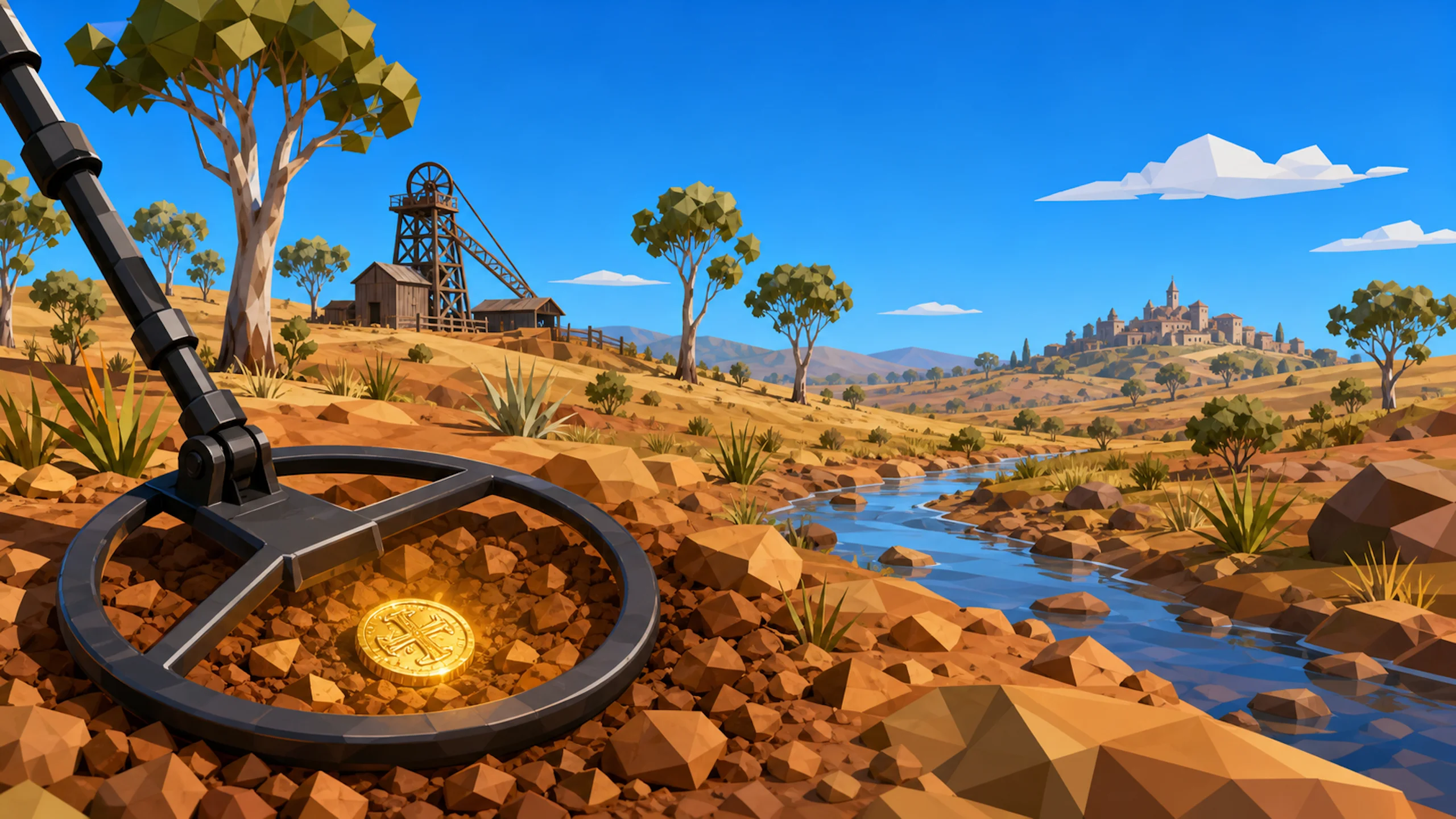
A VR treasure-hunting game built around the oldest thrill there is: the moment the ground gives something up. No combat, no timers — just a detector in your hand, a signal climbing, and a patch of dirt that might be hiding a coin, a nugget, or nothing at all.
Three rules held through the whole build. Every tool is worked with your own hands, never by a button standing in for the thing. Every destination is a real place where real treasure was found, with its real history told straight and its people invented — and the game says which is which. And nothing pressures you: the pace is yours, and getting stuck is a result worth having rather than a failure.
How it is built
Unity 6 with the Universal Render Pipeline, OpenXR, and the Meta XR SDK. It runs natively on Quest 2, Quest 3, Quest 3S and Quest Pro, fully offline once installed, in English and French. It has no accounts, no analytics and no ads — the privacy policy is short because there is little to say.
It released on 26 August 2026 in Early Access on the Meta Horizon Store, and is being extended from there. The updates page keeps the record.
The other Buried Worlds
There is also Buried Worlds on Reddit: a free daily deduction game that plays in a browser. One relic is buried somewhere in a shared field each day; read the detector’s signal and find it in six digs or fewer, then compare routes with everyone else who dug the same field. It is not VR and does not pretend to be — it is the quickest way to try the idea without a headset.
Reaching us
- DiscordThe developer is in there most days. Questions, bug reports, and the first place new destinations get argued about.
- Press kitFact sheet, screenshots, key art and the trailer, free to use in coverage.
- [email protected]For coverage, keys and interviews.
- PrivacyWhat we collect, which is very little, and what we do with it.