Hoxne
A lost hammer, a quiet field, and the largest Roman hoard ever found in Britain.
- Unlocks
- At 8,000 lifetime recovered value
- The verb
- Brush the block
- Your tools
- Detector, pickaxe, a hammer and a cleaning brush
- Buried loot
- Around 2,000 buried items, worth about 22,900 together
- Signature find
- The hoard — nineteen pieces from one find
What it feels like
Quiet English farmland: a goat enclosure, a fence, a dead oak on the rise, a village of houses and a farmhouse that sits dark. This is the most restrained destination in the game and the most deliberately paced.
It is also the only one with no tutorial prompts at all. Hoxne teaches entirely through what is lying around — four clue signs, a hole in a fence, a broken rail in the grass — and at no point does anything tell you what to do next.
The expedition: The lost hammer
Hoxne is built on the real story of how the Hoxne Hoard was found: a detectorist went into a field looking for a hammer a farmer had lost, and found something else. The expedition follows that shape exactly.
- Follow the signs — Four clue signs, each placed within sight of the last, lead from the broken goat enclosure out to the dead oak.
- Find the hammer — Detect it, dig it. It is a tool, not treasure, and it is worth nothing.
- Mend the fence — Carry the fallen panel to its ghost outline. The repair goes in four gated beats, and then you drive the nail — real hammer blows, with the hammer in your hand.
- The field opens — Thurlow’s top field, sealed until now behind a fence ring you can see and walls you cannot, comes open, and the hoard goes live. The farmhouse, dark and bare all game, comes alive: a lantern, a thank-you note signed J.T., and a supper on the table that grants one-strike digging charges. Once per profile.
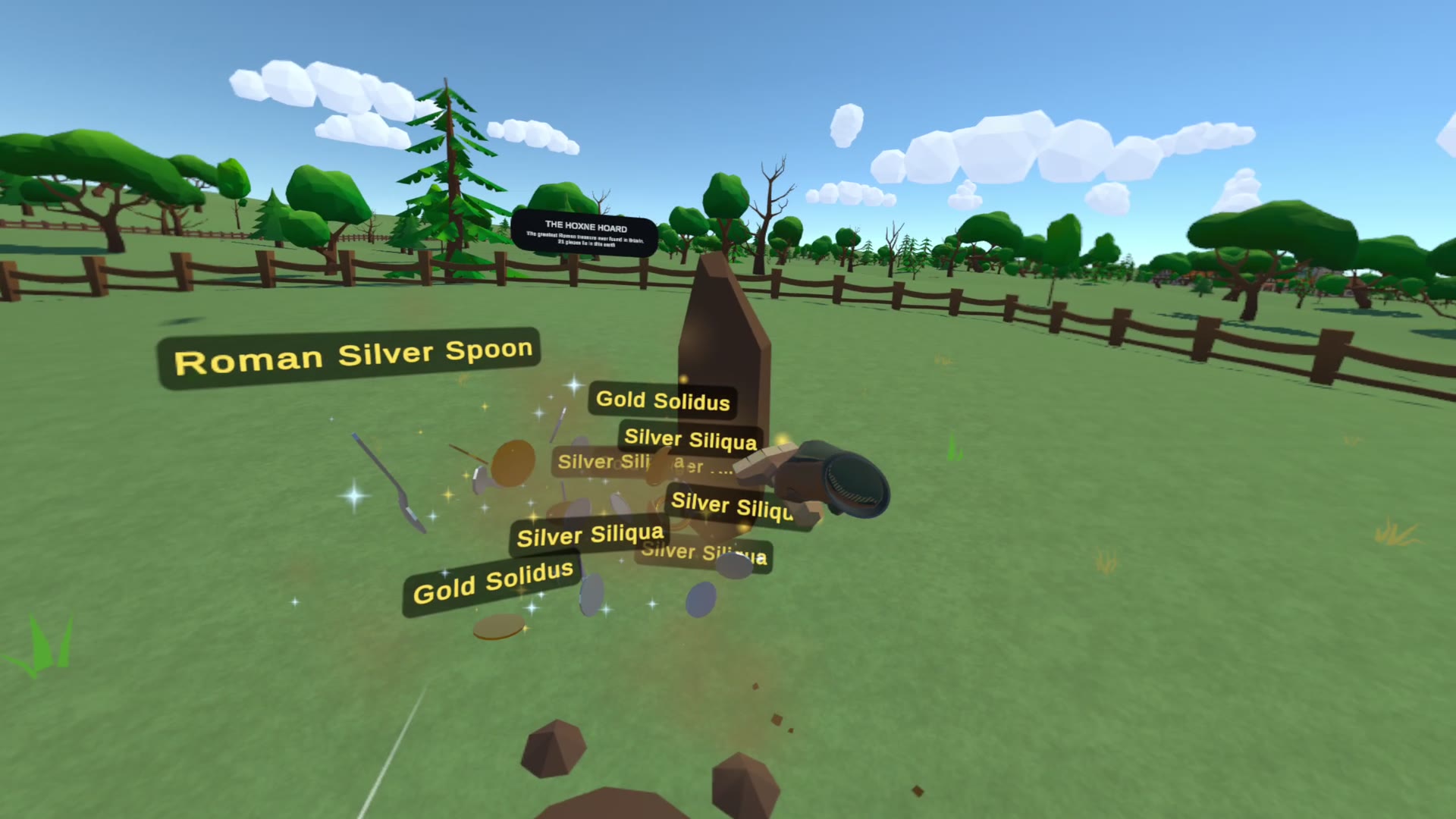
- The hoard — The climax is built to feel unlike anything else in the game. The detector hears one signal. The pickaxe digs one hole. What rises is not a coin but a single block of soil, lifted to chest height. Buy the large cleaning brush — $60, sold only here — and brush the block down stroke by stroke as treasure begins to show through the dirt. A naming card appears and turns gently to face you until the last piece is stowed.
Nineteen pieces come out of that one find spot: ten siliquae, six solidi and three silver spoons, worth 1,570 together.
On the side
House finds
Some pieces sit inside the village houses and need no digging at all. They are simply there, revealed in place — the reward for putting your head through a doorway.
A goat
It walks, it eats, it comes back.
Free prospecting
Around two thousand buried items across the farm and the village, worth roughly 22,900 in all.
The real place
In November 1992, Eric Lawes went into a field at Hoxne with his metal detector to find a hammer his friend, the tenant farmer Peter Whatling, had lost. He found the Hoxne Hoard — the largest hoard of late Roman gold and silver ever discovered in Britain. The hammer was recovered too, and sits with the hoard in the British Museum, Room 49. Eric Lawes and Peter Whatling were real. The farmer you meet in the game is not.
- The Hoxne Hoard: the real storyWhat was in the chest, why it matters, and where to see it.